

ASPN challenges restrictive Medicare coverage determinations for peripheral nerve procedures
The American Society of Pain and Neuroscience (ASPN) has submitted formal comments to the Centers for Medicare & Medicaid Services (CMS) and five Medicare Administrative Contractors (MACs) opposing proposed Local Coverage Determinations (LCDs) that classify genicular radiofrequency ablation (RFA) and other peripheral nerve interventions as “experimental” or “investigational.” ASPN asserts that these procedures are evidence-supported, guideline-endorsed, and represent standard care for chronic pain management. The Society warns that the proposals would create unjust geographic disparities—granting access to beneficiaries in some states while denying identical patients in others—and violate CMS’s statutory obligation to ensure equitable coverage nationwide. ASPN urges CMS to withdraw the draft LCDs, maintain coverage for genicular and other peripheral nerve procedures consistent with published evidence and ASPN STEP Guidelines, and convene a national MEDCAC process to establish uniform policy that preserves patient access to safe, effective interventional pain therapies.

ASPN responds to CMS proposed rule for Physician Fee Schedule (PFS) 2026
The American Society of Pain and Neuroscience (ASPN) has submitted formal comments on the Centers for Medicare & Medicaid Services’ (CMS) proposed 2026 Medicare Physician Fee Schedule (PFS) rule. While supporting increased reimbursement for office-based procedures, telehealth expansion, and chronic care management updates, ASPN strongly opposes certain value-based care provisions that could disadvantage smaller practices. The Society also calls for a taxonomy-based modifier to ensure fair reimbursement for pain specialists, greater transparency in CMS data and audit processes, and protections against efficiency adjustments that may reduce payments for pain procedures. ASPN emphasizes the need for policies that sustain independent practices, promote innovation, and preserve patient access to high-quality pain management care.
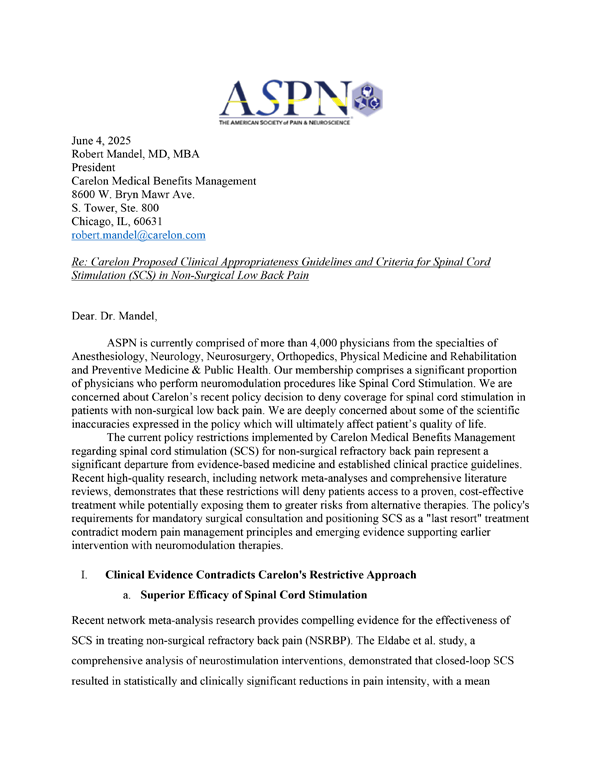
Carelon Proposed Clinical Appropriateness Guidelines and Criteria for Spinal Cord Stimulation (SCS) in Non-Surgical Low Back Pain
The American Society of Pain and Neuroscience (ASPN) has submitted a formal response to Carelon’s proposed restrictions on spinal cord stimulation (SCS) for non-surgical low back pain. Backed by robust clinical evidence and expert consensus, ASPN urges Carelon to revise its policy to reflect modern pain management standards and ensure patients receive timely, effective care.
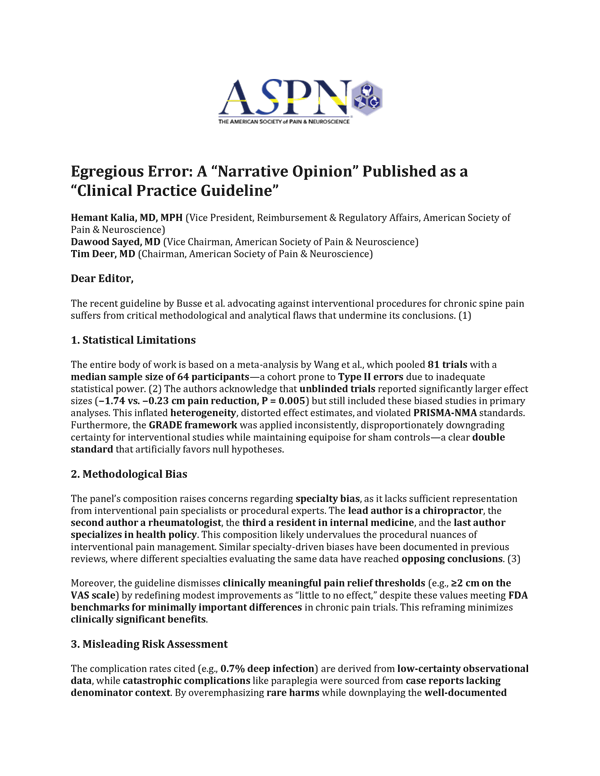
ASPN Response to BMJ’s Clinical Practice Guideline on Chronic Spine Pain
The American Society of Pain & Neuroscience (ASPN) challenges the recent BMJ guideline that opposes interventional procedures for chronic spine pain. This response highlights significant methodological flaws, statistical errors, and bias within the BMJ publication, advocating for scientific integrity and patient access to effective pain management.
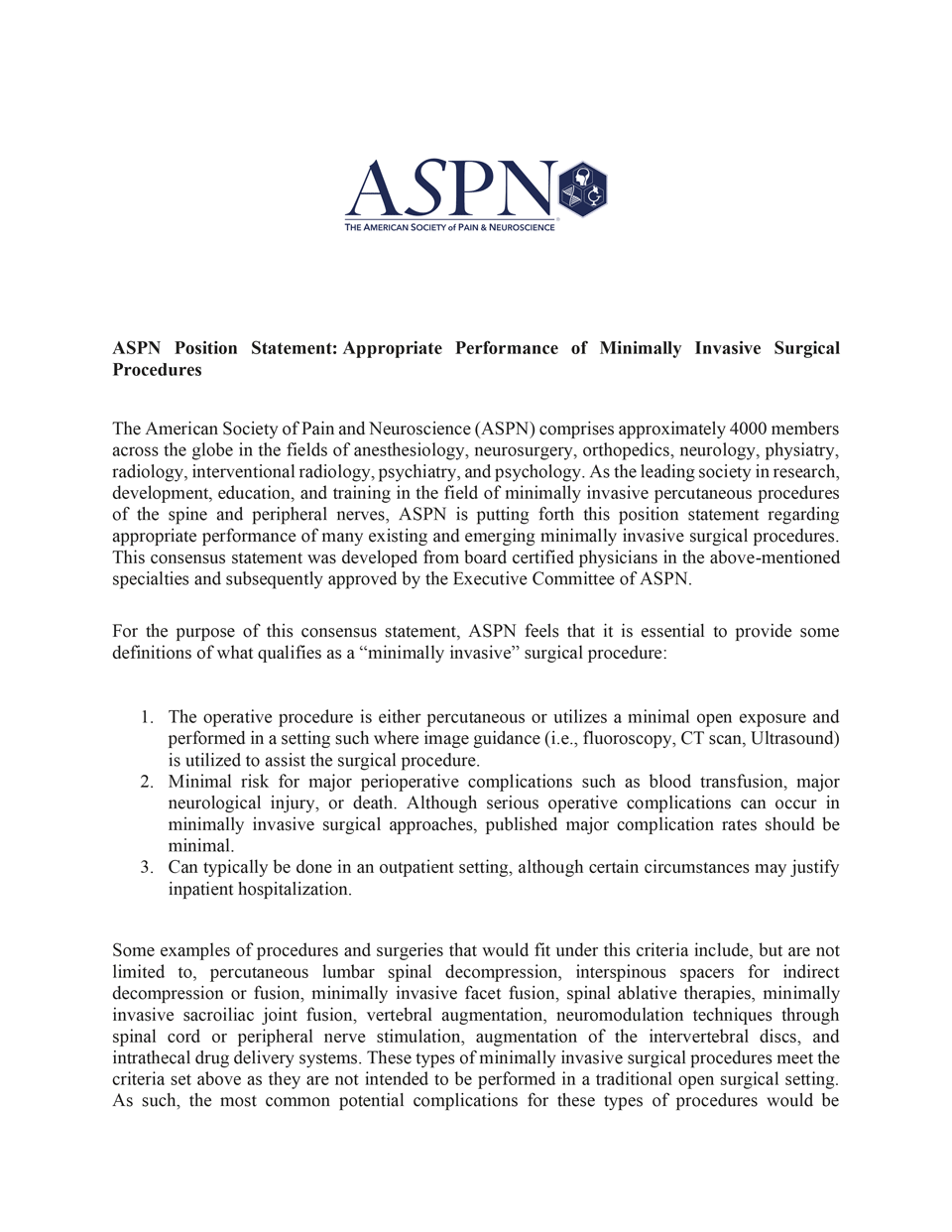
ASPN Position Statement: Appropriate Performance of Minimally Invasive Surgical Procedures
This ASPN position statement outlines the appropriate training, scope, and standards for performing minimally invasive surgical procedures of the spine and peripheral nerves. It emphasizes multidisciplinary collaboration, patient safety, and evidence-based practices.